
A Practical System for Tracking Every Provider Expirable
Every provider in your group carries documents that expire on a fixed schedule. A state license, a DEA registration, a board certification, a malpractice policy, re-credentialing with payors. None of them renew on their own. When one lapses, the provider stays clinically active but becomes invisible to payers, and the claims billed under that provider begin to get denied. Expirables management is the discipline of tracking those dates and renewing each document before the gap ever reaches a payer.
What is expirables management in provider credentialing?
Expirables management is the ongoing process of monitoring and renewing the time-limited credentials a payer requires for continued network participation. It sits inside credentialing but runs on a different rhythm. Initial credentialing is a one-time event. Expirables management runs continuously for the life of every provider contract, because each document has its own renewal cycle and its own consequence when it lapses.
Which provider credentials expire, and how often?
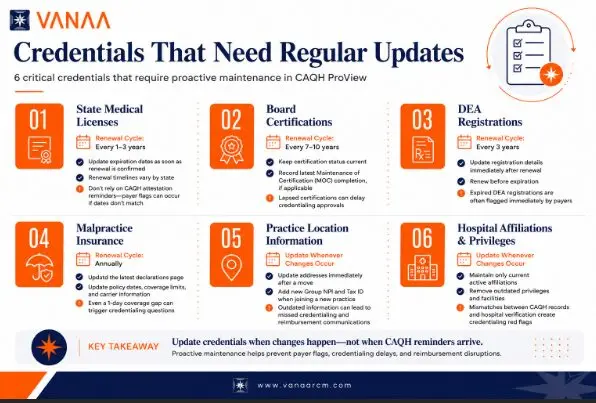
Four credentials drive most lapse-related denials. Each renews on a set timeline:
- State medical license: every 1 to 3 years depending on the state board, required in every state where the provider treats patients, including telehealth.
- DEA registration: every 3 years, required for any provider prescribing controlled substances.
- Board certification: varies by specialty and certifying board, with Maintenance of Certification activities required between cycles.
- Malpractice insurance: annual, with most payers requiring active coverage at minimum limits as a condition of participation.
- Re-credentialing dates: every 2 to 3 years per payer, with each payer running its own cycle independently, so a provider with multiple contracts has renewal deadlines spread across different months and years.
- Hospital privileges: typically a 2-year reappointment cycle per facility, required for any provider delivering care in a hospital or surgery center setting.
Two more belong on any working credentialing checklist: CAQH attestation, which must be refreshed every 120 days, and Medicare revalidation, due every 5 years or every 3 years for providers flagged as high-risk.
Why do lapsed expirables cause claim denials?
Payers confirm credentials through primary source verification, checking each document directly with the issuing body rather than trusting self-reported data. These days they are connected to CAQH and if that is not attested or updated with a current credential the payor takes you off the directory and/or instantly terms you from their enrolled providers list. When a credential lapses, that verification surfaces the gap immediately. The payer can deactivate the provider, place a hold on claims, or deny everything billed during the lapse window.
These denials are difficult to catch because front-end eligibility checks confirm the patient’s coverage, not the provider’s standing. The patient reads as covered. The claim still denies, because the provider is the ineligible party. That mismatch sends the denial into a queue where it ages, since it does not resolve the way a coding or eligibility denial does.
How far in advance should you track expirables?
Renewal does not happen the day you file. State boards and payers take weeks to process, and re-credentialing after a lapse can run 90 to 180 days. A working cadence starts well ahead of each expiration date:
- 120 days out: begin state license and DEA renewals, since board processing times vary by state.
- 90 days out: initiate re-credentialing with each payer ahead of their stated deadline.
- 60 and 30 days out: confirm malpractice renewal with the carrier and update every active payer profile before the prior policy ends.
CAQH should be re-attested every 120 days on your own schedule, not when the reminder email arrives. Tracking these cadences manually across multiple providers and payers is where practices fall behind. This is work built for technology-augmented services, and it is exactly what VANAA delivers through its proprietary platforms.
What does a reliable expirables tracking system include?
Spreadsheets and payer-initiated notices are reactive, and they fail most often in groups adding providers or operating across multiple states, where the volume of expirables multiplies with every new license. A dependable system includes:
- One central record covering every provider, every payer, and every credential type, with renewal ownership clearly assigned.
- Automated alerts at 120, 90, 60, and 30 days before each expiration.
- Proactive CAQH re-attestation that runs independently of payer prompts.
- Verification that public directories and payer records show the same current information for each document.
How a single lapse compounds into lost revenue
One lapsed credential can affect every claim submitted under that provider during the gap. Retroactive billing after renewal is limited and payer-specific, and some payers do not allow it at all, which makes part of that revenue permanently unrecoverable. Treating these as ordinary billing problems is why they cluster in denial management services queues without ever being resolved at the root cause.
Where this fits the broader move to automation
Automation is where the revenue cycle is heading, though adoption remains uneven. About one in five healthcare providers currently apply AI to denials management, according to a 2025 Bain and Company survey cited by HFMA. Most AI investment has gone elsewhere first: ambient listening at 64 percent, clinical documentation improvement and payer compliance at 43 percent, and medical coding at 30 percent.
The readiness gap is real. A February 2026 HFMA survey found that only just over half of finance and revenue cycle leaders consider their teams somewhat prepared (44 percent) or very prepared (about 7 percent) for the revenue cycle of the future. Expirables tracking is one of the clearest places to begin, because the dates are known in advance and the rules do not change.
Make expirables a managed process, not an annual task
Expirables management is a continuous operational function. The practices that see the most credentialing-related denials are rarely failing at initial credentialing. They are losing track of the maintenance cycle that follows. VANAA’s provider credentialing and enrollment services include expirable tracking, proactive renewal, CAQH maintenance, and directory consistency, so no lapse reaches a payer before it is resolved. See how VANAA manages the full credentialing maintenance cycle.
The credentials that cause these denials expire on dates you already have, which makes them among the most preventable losses in the entire revenue cycle.


